
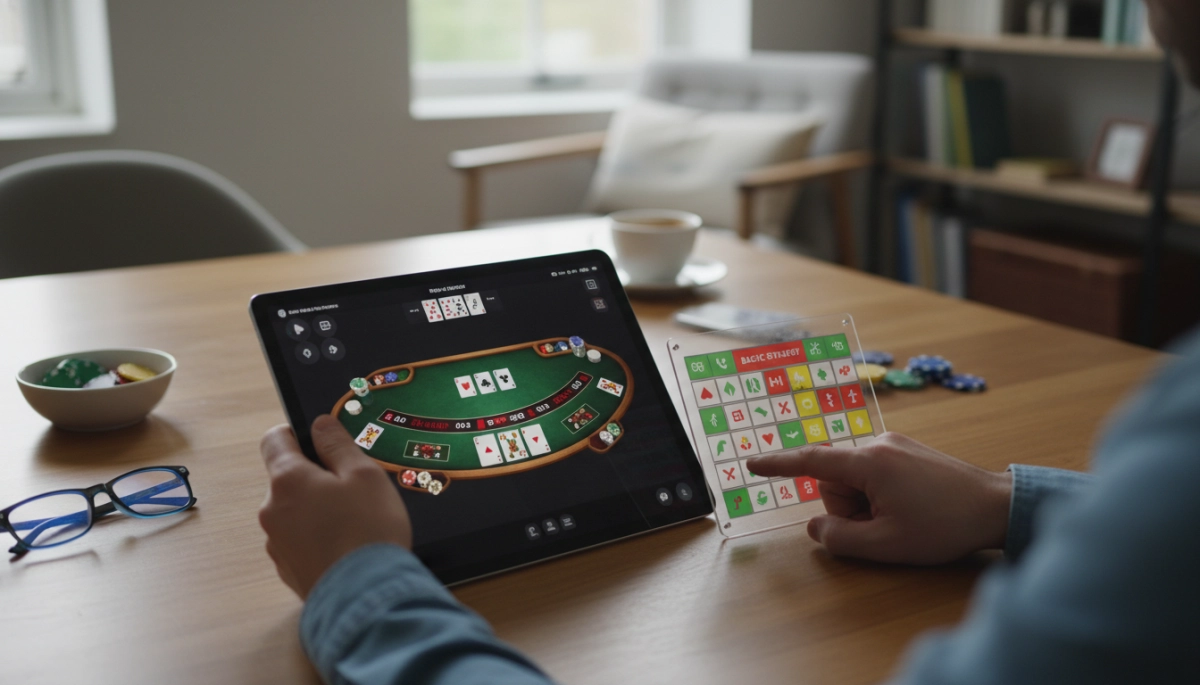
Practice smart: why free online blackjack speeds up your learning
You learn fastest by doing, and free online blackjack gives you the repetitions you need without risking bankroll. When you practice, you train your instincts to follow logic instead of gut feelings. That matters because blackjack rewards consistent, mathematically sound decisions—especially when you use a basic strategy chart. By the time you sit at a real table, you’ll have already experienced dozens or hundreds of common situations, so your responses become automatic.
Using free practice modes also removes pressure. You can pause between hands, compare outcomes, and replay scenarios that confused you. If you treat practice like deliberate study rather than casual play, you’ll notice steady improvement: fewer instinctive mistakes, better bet sizing when appropriate, and sharper recognition of hard totals, soft totals, and pairs.
What you should expect from a practice session
- Short drills: 15–30 minutes focused on one decision type (e.g., whether to split or hit).
- Controlled variables: play at tables with the rules you plan to encounter (number of decks, dealer hits/stands on soft 17).
- Immediate feedback: many free games show correct basic-strategy moves or let you undo plays to see alternate outcomes.
- Progress tracking: note recurring mistakes so you can target them in future sessions.
How the basic strategy chart removes guesswork and lowers the house edge
A basic strategy chart is a distilled set of optimal plays derived from millions of simulated hands. It tells you the statistically best move for every player hand versus the dealer’s upcard. When you follow the chart, you’re not guessing—you are choosing the action that minimizes expected loss over time. That shift from guesswork to strategy is the single biggest factor in improving your blackjack win rate.
Charts vary by rule set, so matching the chart to your game matters. Typical variations include single-deck vs. multi-deck charts and whether the dealer hits or stands on soft 17. In practice, you should:
- Identify the game rules before you begin a session.
- Select the corresponding chart for those rules.
- Focus on learning one portion of the chart at a time—hard totals, soft totals, and pairs.
Simple practice routines that reinforce the chart
Start each session with short, repeatable drills: practice only hard totals 8–17 for 10 hands, then switch to soft totals for 10 hands, then splitting decisions. Use free-play modes that allow you to reset or get hints so you can compare your choice to the chart immediately. Keep a simple log of errors and successes; over several sessions you’ll see patterns and can prioritize which decisions to drill next.
Next, you’ll learn exactly how to read a basic strategy chart step-by-step and apply those rules during play.
Reading a basic strategy chart: step-by-step
Start by getting comfortable with the chart’s layout. Most charts are a grid: the dealer’s upcard runs across the top (2 through A) and your possible hands run down the side. Charts are usually separated into three blocks—hard totals (no Ace or Ace counted as 1), soft totals (hands containing an Ace counted as 11), and pairs (two identical cards). Each cell contains the recommended action for that player hand versus that dealer upcard.
Common abbreviations and how to interpret them:
- H = Hit (take another card).
- S = Stand (take no more cards).
- D = Double if allowed; otherwise Hit (double your bet and take exactly one card).
- Ds = Double if allowed; otherwise Stand.
- P = Split (separate a pair into two hands).
- R or SU = Surrender if allowed; otherwise follow the alternate instruction (often Hit).
Key reading tips:
- Distinguish soft from hard totals. For example, A‑6 is a soft 17—locate it in the soft section, not with “17” in the hard block.
- Know the fallback rules. If the chart presumes doubling after split (DAS) but your game forbids it, alter decisions accordingly—many charts note the alternative.
- Match the chart to the rules before you play. Deck count and whether the dealer hits on soft 17 (H17 vs S17) change several entries, so pick the exact chart for your table.
Applying the chart at the virtual table: drills and practical tips
Reading the chart is one thing; applying it under pressure is another. Free online blackjack practice is ideal for building that muscle memory. Use these targeted drills to internalize the most important decisions.
- One-decision focus (10–20 minutes): Choose a single category—hard totals, soft totals, or pairs. Play only hands from that category (many trainers let you force specific starting hands) and always consult the chart before acting. Track your accuracy percentage.
- Time-pressure drill: Give yourself a 5–8 second decision window. This trains fast recognition so you won’t freeze at a live table.
- Double/split practice: Run 30 hands where you only practice doubling and splitting scenarios. Make sure you include split-aces and soft-double situations.
- Error log and micro goals: Keep a brief log of mistakes and set a goal (e.g., reduce errors on soft totals to under 5% in a week).
Use trainer features available in many free games: hint modes that reveal the chart’s move, “undo” to experiment with alternative plays, and rule toggles to switch between single- and multi-deck play or H17/S17. Start each session by confirming game rules and selecting the matching chart. If a trainer lets you enforce the chart (forcing the correct move), occasionally use that to “lock in” patterns, then switch back to free mode to test recall.
Watch for common pitfalls: misreading Aces (soft vs hard), forgetting the fallback when doubling after split isn’t allowed, and mistaking surrender options. Also resist taking insurance—basic strategy nearly always advises against it unless you’re counting. With short, focused drills and regular review, the chart will shift from reference tool to automatic response, and your practice gains will transfer smoothly to real play.
From practice to confident play
Keep the momentum going: short, deliberate practice beats long, unfocused sessions. Let the basic strategy chart guide your decisions until those plays become second nature, then test your recall under time pressure and in low‑stakes environments. Balance repetition with reflection—review your error log after each session and use that feedback to shape the next drill.
Quick action steps
- Schedule 3–5 focused practice sessions each week (15–30 minutes each).
- Rotate drills: hard totals, soft totals, and pairs—one category per session.
- Use trainer features (hints, undo, rule toggles) to compare choices to the chart immediately.
- Keep a simple error log and set small improvement goals for the week.
- When ready, move to low‑stakes real tables to practice tempo and table etiquette.
For reliable charts and deeper explanation of rule variations, consult a trusted resource like the Wizard of Odds basic strategy guide. With consistency and the right drills, your chart will stop being a reference and start being your automatic playbook—exactly where you want it to be before you bet real money.