
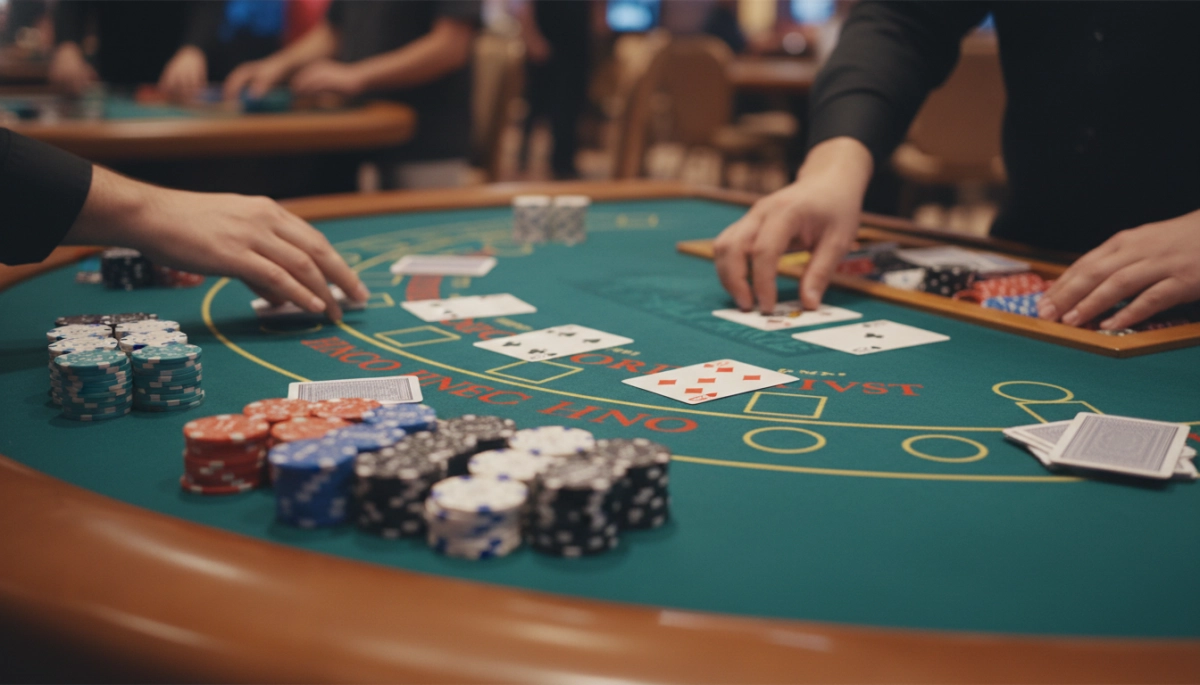
How the rules and payouts shape what you can expect at the table
When you sit down at a blackjack table, the two most important things that determine your long-term results are the rules in play and the payouts offered. Knowing rules like whether the dealer hits on soft 17, whether you can double after splitting, and whether a blackjack pays 3:2 or 6:5 changes the mathematical edge the house holds and therefore your expected return. This section helps you identify the rule differences and payout patterns that have the biggest impact on outcomes so you can compare games and make smarter decisions.
Key rule variations that move the expected return
Not all blackjack tables are the same. The following list highlights the common rule variations that meaningfully affect expected return:
- Blackjack payout (3:2 vs 6:5): A natural blackjack that pays 3:2 is far kinder than one paying 6:5. That payout directly increases your expected value when you hit blackjacks.
- Dealer behavior (Stand or Hit on soft 17): If the dealer hits on soft 17 (H17), the house edge increases slightly compared with when the dealer stands (S17).
- Number of decks: Fewer decks generally reduce the house edge, but the effect can be small compared to payouts and dealer rules.
- Doubling rules: Being allowed to double on any two cards and after splits gives you more opportunities to increase EV on favorable hands.
- Resplitting and surrender: Options like resplitting aces or late surrender can shave points off the house edge when used correctly.
Understanding standard payouts and side options
The baseline payout structure is simple, but optional side rules and side bets complicate the math. Standard outcomes and their usual payouts are:
- Blackjack (ace + ten-value) — typically pays 3:2 (sometimes 6:5).
- Winning hand — pays 1:1.
- Insurance — pays 2:1 but is generally a negative expected value play unless you have specific counting information.
- Pushing (tie) — you retain your bet; push frequency affects variance but not expected return when all else is equal.
Side bets (pair bets, 21+3, insurance) have their own payout tables and carry much higher house edges. Treat these as separate games; they rarely improve your expected return compared with focusing on base-game strategy.
Translating rules and payouts into the elements of expected return
To calculate expected return you’ll combine probabilities of different outcomes with their respective payouts. That means estimating the likelihood of blackjacks, dealer busts, pushes, and wins given the specific rule set, then multiplying those probabilities by the payout for each outcome. Rule changes shift the probabilities, and payout changes scale the results — both must be accounted for to get an accurate expected return.
Next, you’ll see a step-by-step method to compute expected return for a given rule set, including worked examples that show how small rule changes modify the final percentage.
Step-by-step calculation: converting probabilities and payouts into expected return
Calculating expected return (ER) for a specific blackjack rule set is straightforward in principle: ER is the sum of each outcome’s probability multiplied by its net payoff. In practice you’ll assemble probabilities for blackjack, regular wins, pushes and losses under the rules you’re evaluating, then weight those by the payout for each outcome.
Follow these steps:
- 1. List the relevant outcomes. At minimum: player blackjack, player win (non-blackjack), push, player loss. If you use surrender or insurance, include those outcomes separately.
- 2. Determine probabilities under the rule set. Use simulation, published tables, or approximations from basic-strategy metrics to estimate P(blackjack), P(win), P(push), P(loss). Ensure they sum to 1.
- 3. Assign net payouts. For a 1-unit bet: blackjack pays +1.5 units on a 3:2 table (or +0.2 units on a 6:5 table), a regular win pays +1, a loss is −1, a push is 0. Surrender/insurance have their own nets.
- 4. Multiply and sum. ER = Σ [P(outcome) × net payout]. The result is the expected profit per unit bet (can be negative). Express as a percentage of the bet to get the house edge (negative ER) or player advantage (positive ER).
- 5. Adjust for additional rules. If rules change (dealer S17 vs H17, doubling restrictions, deck count), repeat steps 2–4 with updated probabilities or apply known delta adjustments to ER (see worked examples below).
Example (symbolic): ER = P(BJ)×1.5 + P(win)×1 + P(push)×0 − P(loss)×1. If you prefer dollars, multiply ER by your bet size to get expected dollars won/lost per hand.
Worked examples: small rule changes and how they shift expected return
Instead of re-simulating every change, you can often use standard adjustments to the baseline house edge. Typical basic-strategy baselines for favorable casino rules (multiple decks, S17, double after split allowed) yield an ER around −0.5% (house edge ≈0.5%). Below are illustrative, commonly cited impacts (approximate):
- Dealer hits soft 17 (H17): adds about 0.2% to the house edge. If baseline ER = −0.50%, switching to H17 ≈ −0.70%.
- Blackjack payout cuts from 3:2 to 6:5: costs roughly 1.3–1.5% (varies by deck count). From baseline −0.50% to about −1.80% to −2.00%.
- Restricting doubling (e.g., only on 10–11): typically costs ~0.1–0.3% depending on other rules.
Combine effects by adding the deltas. Example calculations per $100 bet:
- Baseline (S17, 3:2, liberal doubling): ER = −0.50% → expected loss $0.50 per $100 bet.
- Make dealer H17: ER ≈ −0.70% → expected loss $0.70 per $100.
- Change to 6:5 blackjack instead of 3:2 (keeping H17): add ~1.4% → ER ≈ −2.10% → expected loss $2.10 per $100.
Practical translation to hourly loss: if you play 100 hands per hour at $10 per hand, a −0.50% edge costs about $5/hour; with the worse H17 + 6:5 combination (≈−2.10%), the cost jumps to about $21/hour. These examples show how small percentage-point shifts in ER quickly scale into meaningful bankroll impact — use them to compare tables and choose the game with the smallest negative ER before you even sit down.
Practical table‑selection checklist
- Prefer tables that pay 3:2 for a natural blackjack; avoid 6:5 when possible.
- Look for S17 (dealer stands on soft 17) and liberal doubling/splitting rules, including doubling after split and resplitting aces if offered.
- Fewer decks is generally better, but confirm other rules first—payouts and dealer behavior matter more than deck count alone.
- Avoid tables with expensive side bets unless you understand their separate house edges.
- Use estimated ER numbers (or a quick calculator) to compare tables before committing a session or increasing bet size.
Tools and practice
Before you play for real money, practice basic strategy and experiment with calculators or small simulations to see how rule changes affect your expected return. Trusted resources such as the Wizard of Odds blackjack resources offer calculators and rule‑impact tables that make it easy to translate rules into dollars per hour for the stakes you plan to play.
Putting the math to work at the table
Knowing how rules and payouts change expected return gives you a clear, objective way to choose which games to play and how to size your bets. Use the checklist and tools above, stick to basic strategy, and manage your bankroll so that the small percentage differences between tables don’t become big surprises. With disciplined play and rule‑aware table selection, you’ll make better decisions and understand the true cost (or value) of each hand you sit down to play.