
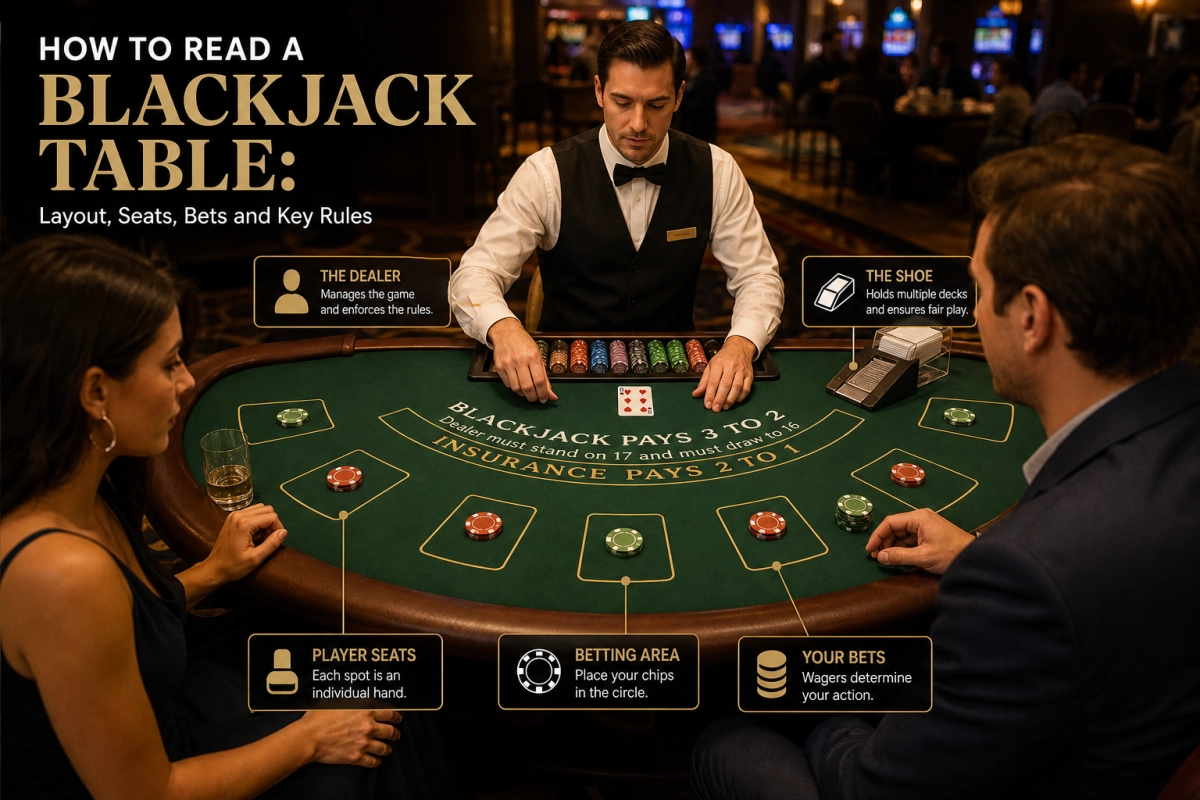
Understanding the blackjack table: layout, seats and betting basics
The blackjack table is the starting point for every hand. This guide explains the blackjack table in plain language and shows what markings, seats and wagers mean. Readers will learn how minimum and maximum bets work, basic table etiquette, common rule variations (like dealer hits soft 17, doubling and splitting rules), and how those rules change the house edge and basic strategy choices.
Table layout and common markings
Blackjack tables vary between casinos but share the same essentials. Knowing the layout helps a player place legal bets and follow the flow of the game.
- Betting circles/boxes: Designated spots in front of each seat where chips are placed for a hand.
- Dealer area and shoe: The dealer stands behind a marked semicircle. Many casinos use a shoe (a device that holds multiple decks). A cut card inside the shoe signals when the shoe will end.
- Insurance line: A small area above the betting box used when the dealer shows an Ace — a side bet to protect against dealer blackjack.
- Blackjack payout printed: Some tables show “3:2” or “6:5” near the dealer — these are payout rates for a natural blackjack (Ace + 10-value card).
- Minimum/maximum signs: Usually posted on or near the table cloth (e.g., $5–$500).
Seating, wagering rules and bet limits
Where a player sits and how they place bets follows simple rules. Observing these prevents mistakes and confusion.
Seating order and joining a game
Players sit at available seats and place a bet in a betting box to join the next round. If seats are full, wait for the next hand or ask the dealer about the pit’s rules for joining mid-shoe.
Minimum and maximum bets
Every table enforces a posted minimum and maximum. Examples:
- At a $10–$500 table, the smallest bet accepted is $10 and the largest single-hand wager is $500.
- Some casinos allow higher maximums on heads-up play (one player vs dealer).
Always place chips fully inside the betting box. Placing chips partly outside can be treated as an unclear bet and risks dealer error.
Common rule variations and quick effects on play
Rule differences change both the house edge (the casino’s mathematical advantage) and the basic strategy a player should use. Key variations include:
- Dealer hits vs stands on soft 17 (H17 vs S17): If the dealer hits a soft 17 (Ace + 6), the house edge increases slightly (about 0.2–0.3%). Basic strategy adjusts: players hit or double differently on soft hands.
- Payout for blackjack (3:2 vs 6:5): A 6:5 payout greatly increases house edge compared with 3:2 — avoid 6:5 tables when possible.
- Doubling rules: Restrictions such as “double only on 9–11” raise house edge and limit profitable doubling opportunities.
- Splitting rules: Whether re-splitting Aces is allowed affects the expected return when dealt pairs.
These rule changes often require small but important basic strategy adjustments. The next section will show exact strategy tweaks, payouts and how side bets work, plus a practical example that ties table rules to expected house edge.
Specific basic-strategy adjustments for common rule changes
Different table rules don’t just change the math — they change a few specific choices you should make when playing. You don’t need to memorize a dozen charts right away, but learn the few adjustments below so your play stays close to optimal.
– Dealer hits vs stands on soft 17 (H17 vs S17): When the dealer hits on soft 17 the house gets a small edge boost and the dealer is a bit more likely to improve soft totals. The practical effect: be slightly more conservative with soft hands — you’ll double and stand a bit less often on soft totals than you would at an S17 table. If you’re uncertain, use a basic-strategy chart that matches H17 versus S17.
– Doubling restrictions: If a table restricts doubling (for example, “double on 9–11 only” or “no double after split”), your doubling opportunities shrink and the house edge rises. Adjust by avoiding marginal doubles you’d only take under liberal rules, and be less inclined to split small pairs if you can’t double after splitting — splitting is less valuable when you can’t follow up with a double.
– Splitting rules (resplitting Aces, splitting 10s): Always split Aces and 8s when allowed. If the casino forbids resplitting, treat some pair-splitting situations more cautiously (2s/3s or 6s) because you can’t get extra profitable splits. Never split 10s — that rule holds across almost every chart.
– Blackjack payout differences: A table paying 6:5 for blackjack instead of 3:2 massively hurts the player’s return. At a 6:5 table, basic strategy still applies, but the math is so unfavorable that experienced players usually avoid those tables altogether.
If you want exact moves for every hand, download or carry the correct basic-strategy card that matches the table rules (number of decks, H17/S17, DAS/no DAS). A few minutes of reference will prevent costly mistakes.
Payouts, side bets and how they affect the house edge
Payouts and optional side bets are where the casino builds extra profit. Know which bets to accept and which to avoid.
– Blackjack payout: A natural usually pays 3:2 at fair tables. If you see 6:5 printed, be wary — it increases the house edge substantially and turns a long-term losing proposition for most players.
– Insurance: This is a separate bet when the dealer shows an Ace. It’s essentially a wager on whether the dealer has blackjack and, for most players, has a negative expected value. Decline insurance unless you are counting cards or have a specific advantage.
– Common side bets: Perfect Pairs (pays when your first two cards make a pair), 21+3 (combines your cards with the dealer’s upcard for poker hands), and progressive bonuses. Payouts vary, but these bets typically carry much higher house edges than the main game — sometimes several percent to double-digit percentages. Treat them as entertainment bets, not value bets.
– How rules change the house edge: Small rule shifts add up. H17 instead of S17 typically adds a few tenths of a percent to the house edge. Limiting doubles or splits also raises the edge incrementally. Conversely, allowing double after split or resplitting Aces slightly reduces the house edge. When choosing tables, favor better payout and liberal doubling/splitting rules.
Table etiquette, simple bankroll rules and responsible play
Good manners and money sense keep the game pleasant and sustainable.
– Table etiquette: Place chips in the betting circle, wait for the dealer to finish a hand before touching chips, don’t interfere with other players’ decisions, announce “stand,” “hit,” “double” or “split” clearly, and tip the dealer if you’re winning or receiving good service. Never use your phone at the felt or slow the game.
– Bankroll basics: Decide how much you can afford to lose before you sit. A conservative rule is 1–2% of your bankroll per bet; 3–5% is aggressive and increases the chance of a quick bust. Use session limits (stop-loss and win-goal) to avoid playing emotionally.
– Responsible gambling: Set time and money limits, take breaks, don’t chase losses, and seek help if gambling stops being fun. Casinos and national helplines offer resources and self-exclusion programs if needed.
These practical habits — matching your strategy to the rules, avoiding poor side bets, and managing money and behavior — will keep you playing longer and smarter at the blackjack table.
Final thoughts and next steps
You now have the basics to approach a blackjack table with confidence. The most important next steps are practical: start small, pay attention to the table rules, and focus on making the right decisions hand by hand. Keep gambling fun and controlled — the goal is steady, informed play rather than chasing quick wins.
Quick pre-seat checklist
- Confirm the table’s minimum/maximum and the blackjack payout (prefer 3:2 over 6:5).
- Note whether the dealer hits or stands on soft 17 and any doubling/splitting restrictions.
- Decide your session bankroll and set a stop-loss and a win-goal before you start.
- Have the correct basic-strategy reference for the table rules handy (print or app).
- Avoid insurance unless you have a clear advantage; treat side bets as entertainment.
- Place chips fully inside the betting box and follow basic table etiquette to keep the game moving.
Playing mindset
Think of blackjack as a skill you improve with practice. Concentrate on decision quality, not short-term results. Take breaks, manage your bankroll, and never gamble with money you can’t afford to lose. If play stops being enjoyable or becomes risky, step away and use available help resources.