
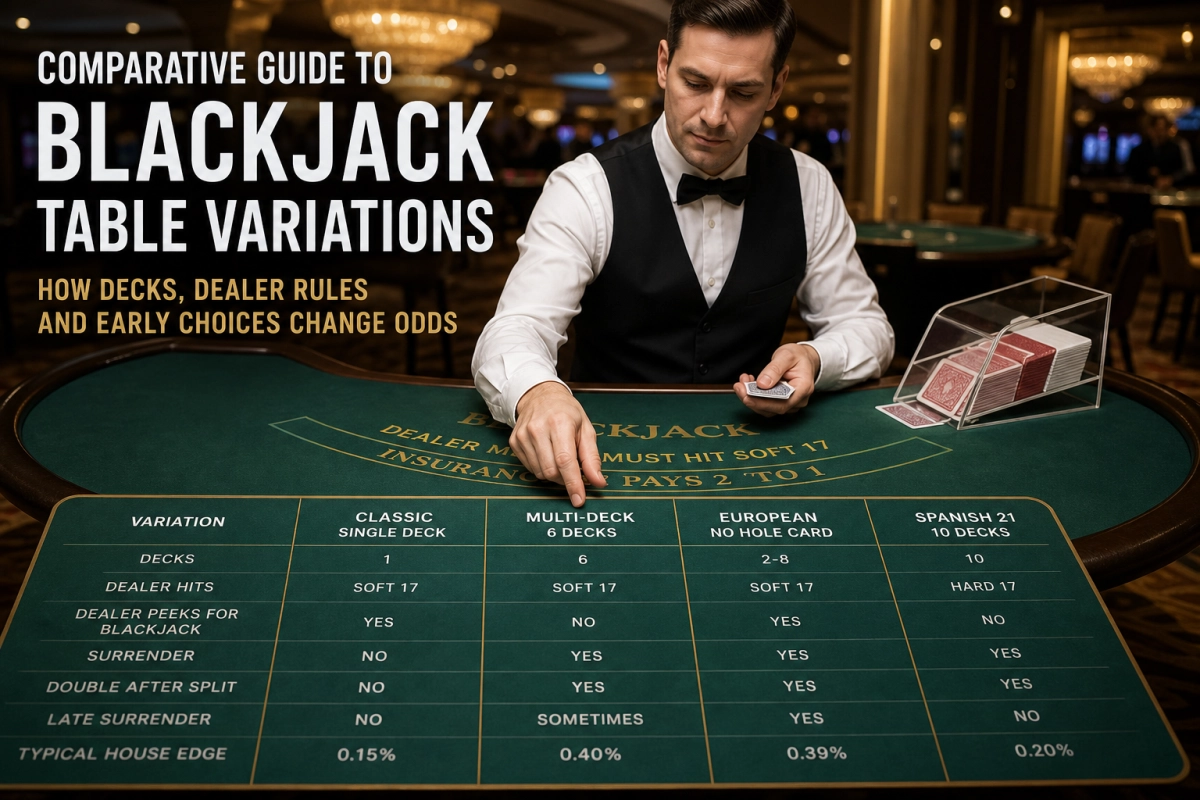
How blackjack table rules change your edge and strategy
This guide explains how common differences at a blackjack table affect the house edge, force small basic-strategy changes and influence bankroll choices. Readers will learn why a shift from single-deck to six-deck, or a rule like “dealer hits soft 17”, matters in practical terms — with clear examples and responsible playing advice for both beginners and experienced players.
Why small rule changes matter at the blackjack table
“House edge” is the casino’s long-term advantage expressed as a percentage of wagers. “Basic strategy” is the mathematically optimal decision chart that minimizes that edge. Small rule changes at a blackjack table — number of decks, whether the dealer hits soft 17 (H17) or stands (S17), doubling and split permissions, and surrender options — shift the house edge by key basis points. Those shifts change expected losses per hour and therefore affect how much bankroll a player should bring.
- Beginner takeaway: choose tables with friendlier rules (fewer decks, S17, double after split, late surrender) to reduce the casino advantage.
- Experienced-player takeaway: small percentage differences add up with high stakes or long sessions; use the precise rule set to select correct basic-strategy charts and bankroll sizing.
Number of decks: how deck count shifts odds and strategy
Deck count on a blackjack table (single-deck, double-deck, four-deck, six-deck, eight-deck) affects the frequency of certain card combinations and thus the house edge. The deck effect is real but modest compared with major rule changes.
House edge impact
Generally, moving from a single-deck to a multi-deck game increases the house edge by a small but meaningful amount. As a rule of thumb, single-deck games can be noticeably friendlier; moving to six- or eight-deck games often increases the house edge by roughly a few tenths of a percentage point depending on the full rule set. In plain terms: a game that is about 0.4% house edge in single-deck formats might be closer to 0.6%–0.7% in six-deck form with otherwise identical rules.
How strategy and bankroll change
Most basic-strategy decisions remain similar across deck counts, but a few marginal plays (like certain soft hands and some doubling spots) change enough to require a different chart. For bankroll planning, expect slightly higher expected loss per hour in multi-deck games; players should increase session bankroll accordingly — roughly proportional to the higher house edge and session length. For example, if a typical one-hour session at single-deck has an expected loss of $4 at $10 bets, a six-deck version with a ~0.2% higher edge would increase expected loss by about $2 per hour at the same stakes.
Dealer hits or stands on soft 17: a small rule with significant effect
Soft 17 (any hand containing an ace counted as 11 that totals 17, e.g., A-6) is treated differently across casinos. If a dealer hits soft 17 (H17), the casino gains an edge; if the dealer stands (S17) the game is friendlier to the player.
Practical effect and example
Allowing the dealer to hit soft 17 typically increases the house edge by about 0.2 percentage points. Example: under S17 a rule set might yield a 0.5% house edge; switching to H17 often raises that to about 0.7%. That change also alters some basic-strategy moves for soft hands — players must consult an H17-specific chart to avoid tiny but costly mistakes.
Next, the guide will explain how doubling and split rules, surrender options, common side bets and table limits each change the house edge, shift basic strategy choices and affect how large a bankroll players should carry for short sessions and long sessions.
Doubling and splitting: rules that directly affect edge and variance
Doubling and splitting permissions are among the most player-favorable rules when they are liberal, and among the most punitive when they’re restricted. A table that allows doubling on any two cards and permits doubling after a split (DAS) typically lowers the house edge by several tenths of a percent compared with one that restricts doubling to 9–11 and forbids DAS.
House edge and strategy implications
Example impacts: allowing DAS often reduces house edge by roughly 0.08%–0.15% versus “no DAS.” Allowing doubling on any two cards instead of only 9–11 can shave another ~0.05%–0.10%. Conversely, rules that ban re-splitting (especially aces) or force only one card to split aces can add ~0.10%–0.20% to the house edge compared to fully liberal split rules.
Basic-strategy effects are precise but small: with DAS you’ll split more aggressively (for example, splitting 2s and 3s against dealer 4–7 more often) and you’ll double on a few extra soft or hard totals when doubling is allowed on any two cards. If re-splitting is forbidden, you must treat some split hands more conservatively (sometimes taking a double or hit instead of splitting again).
Bankroll and variance guidance
Permissive doubling/splitting lowers expected loss per bet unit but increases session volatility because doubling multiplies bet size on favorable hands. For beginners: favor DAS and “double any two” tables to minimize house edge but keep single-unit bankroll sizing modest—aim for at least 100–200 units (one unit = your standard bet) to weather variance. Experienced players who use larger bet spreads should recognize that more doubling requires a larger reserve to survive swings even though the long-term edge improves.
Surrender rules: late vs early and their practical value
Surrender lets you forfeit half your bet and end a hand. Late surrender (LS) — allowed only after dealer checks for blackjack — is common and yields modest player benefit; early surrender (ES) — allowed before the dealer checks — is rare and much stronger.
Typical effect sizes: late surrender reduces house edge by roughly 0.07%–0.20% depending on the full rule set and when it’s used. Early surrender can reduce edge by several tenths more, making it a powerful rule for advantage-oriented players. Strategy changes are straightforward: basic charts add surrender entries (for example, surrender 16 vs dealer 9–10–A in many LS charts). If you play a game with surrender, use the matching chart — failing to surrender when correct costs more than the small raw edge change suggests.
Bankroll note: surrender lowers expected loss per hand, so required session bankroll can be slightly smaller for the same tolerance of loss. However, surrender also reduces volatility (because you cut big losing hands), which is beneficial to conservative bankroll management.
Side bets and table limits: volatility, hidden edges and practical bankroll effects
Side bets (Insurance, Perfect Pairs, 21+3, etc.) are attractive for the chance of a large payoff, but they almost always carry significantly higher house edges than main-hand blackjack — often from ~2% up to 10% or more depending on the bet and pay tables. Insurance is a special case: it’s essentially a separate proposition with a long-term negative expectation for non-counters (roughly equivalent to a -6% to -7% bet if dealer blackjack probability is fair).
Side bets don’t change basic strategy for the main hand, but they change bankroll allocation: a side-bet addict must accept a much higher expected hourly loss and volatility. Beginners should avoid side bets or treat them as entertainment money; experienced players should only play them with clear knowledge of pay tables or when a specific count gives a positive expectation.
Table limits determine how much you can scale bets. For casual players pick tables with a sensible min relative to your unit size. For advantage play or long sessions ensure the max bet supports your intended bet spread; otherwise a favorable rule set is moot because you can’t raise bets when the count or edge turns positive. As a rule of thumb, plan session bankrolls in units: casual sessions 100–200 units, more aggressive or professional sessions several thousand units depending on expected variance and required bet ramp.
Putting rules together when choosing a table
Example: how small rule differences affect expected loss
Use a simple, practical calculation to compare tables. If you play 100 hands in an hour at a $10 bet, a game with a 0.5% house edge gives an expected loss of 100 × $10 × 0.005 = $5/hour. If a different table’s rules raise the edge to 0.7%, your expected loss becomes $7/hour — a $2/hour difference from a single rule-set change. Over many sessions that gap compounds, and it’s the reason rule-selection and correct basic-strategy charts matter.
Practical selection checklist
- Confirm the deck count, S17 vs H17, DAS and doubling rules, and surrender availability before sitting down.
- Match your basic-strategy chart to the exact rule set at the table — small mismatches cost real money.
- Ignore most side bets unless you’re playing them purely for entertainment or you have a documented positive expectation (rare without counting).
- Set unit size relative to table minimums and your bankroll: casual play ≈ 100–200 units; longer or more aggressive sessions require many more units.
- If you plan to vary bets (counting or progressive staking), ensure the table’s maximum bet supports your intended spread; otherwise favorable rules can’t be leveraged.
Parting advice for table hunters
Pick tables intentionally: identify the few rules that matter most to your goals (minimizing house edge, reducing variance, or maximizing entertainment) and commit to the matching basic-strategy chart. Practice decisions in a low-stakes or simulator environment until the correct plays for that rule set are automatic. Manage bankroll conservatively — set session limits, accept variance, and avoid side bets as a steady strategy. Finally, treat blackjack as a skill-based form of entertainment: make rule-based choices, track results, and stop when the play no longer fits your goals or bankroll. Safe, informed play is the best way to get consistent value from the table experience.