

How mastering basic strategy changes your game and why you should care
When you play blackjack, every decision—hit, stand, double, or split—affects the long-term outcome. Basic strategy is a mathematically derived set of rules that tells you the best action for every two-card player hand vs. the dealer’s upcard. By following it, you reduce the house edge to its minimum for standard rules and put variance and luck into the proper perspective.
You don’t need perfect memory or advanced math to use basic strategy. You need to understand three core categories of hands, know how the dealer’s upcard influences choices, and practice a few simple rules until they become automatic. In the sections that follow you’ll learn the underlying logic and the practical rules you can apply immediately at the table.
Understand the three hand types and the dealer upcard influence
Basic strategy hinges on two things: the type of hand you hold and the dealer’s visible upcard. Learn to classify your hand quickly and evaluate risk based on the dealer’s likely outcome.
- Hard totals: A hand without an ace counted as 11 (or with an ace counted as 1). Examples: 8, 12, 16.
- Soft totals: Any hand that includes an ace counted as 11, e.g., A-6 (soft 17) or A-8 (soft 19).
- Pairs: Two cards of identical rank e.g., 8-8, 9-9, A-A—these present splitting opportunities.
The dealer’s upcard divides into two general groups: weak cards (2–6) and strong cards (7–Ace). If the dealer shows 2–6, they are more likely to bust; against those upcards you will often stand on lower totals and double or split more aggressively. If the dealer shows 7–Ace, they are likely to make a strong final total; you must be more conservative and take additional cards to improve your hand.
Quick reference rules you can memorize first
- Hard totals: Always stand on hard 17 and up. Hit on hard 8 and below. With hard 12–16, stand when the dealer shows 2–6, hit when the dealer shows 7–Ace.
- Soft totals: Treat soft hands more aggressively—double when possible: for example, with soft 13–18 you often double vs. dealer 5–6 (and hit otherwise). Always hit soft 17 or less unless doubling is recommended.
- Pairs: Always split A-A and 8-8. Split 2-2, 3-3, 6-6, 7-7 against dealer 2–7 depending on rules; never split 10-10 or 5-5 (5-5 should be played as a hard 10 and doubled against 2–9).
These rules are a practical starting point, but exact plays can vary slightly by casino rules (number of decks, dealer hits/stands on soft 17, surrender options). Practice these fundamentals first so you can focus on small rule differences later.
Next, you will learn the complete basic strategy chart and step-by-step examples that show how to apply each rule in real hands at the table.

Read the complete basic strategy chart — what each cell means
Before we show examples, you must know how to read a full basic strategy chart. Charts are arranged with your player hands down the left (hard totals, soft totals, pairs) and the dealer’s upcard across the top. Each cell prescribes the mathematically optimal play: H (hit), S (stand), D (double if allowed, otherwise hit), Ds (double if allowed, otherwise stand), P (split), or R (surrender if available, otherwise hit/stand as noted).
For a commonly used rule set (multiple decks, dealer stands on soft 17, doubling allowed on any two cards, double after split allowed), some specific, often-missed details are:
– Hard totals: hard 17+ = always stand. Hard 13–16 = generally stand vs dealer 2–6, hit vs 7–Ace. Hard 12 is the exception: stand vs dealer 4–6, hit vs 2–3 and 7–Ace.
– Soft totals: soft hands are more flexible. For example, soft 13–14 (A-2, A-3) double vs dealer 5–6; soft 15–16 double vs 4–6; soft 17 (A-6) double vs 3–6; soft 18 (A-7) doubles vs 3–6, stands vs 2, 7, 8, and hits vs 9–Ace.
– Pairs: Always split A-A and 8-8. Never split 10-10 or 5-5 (play 5-5 as a hard 10 and double vs 2–9). Split 2-2 and 3-3 vs dealer 2–7 (variations apply vs 7), split 6-6 vs 2–6, split 7-7 vs 2–7, and split 9-9 vs 2–6 and 8–9 (stand vs 7, 10, Ace).
Charts will often mark double-as-hit or double-as-stand fallback behavior; memorize the fallback (usually hit for D, stand for Ds). Print or memorize one chart that matches the casino rules you play — it’s the fastest way to internalize exact plays.
Step-by-step examples: apply strategy on real hands
Practice applying the chart with concrete hands. Here are common situations and the logic behind each correct play.
Example 1 — Hard 16 vs dealer 10
– If late surrender is allowed, surrender 16 vs 10. If not, hit (never stand). Why: dealer strong upcard makes standing hopeless; hitting lowers the long-term loss even though many individual hands still bust.
Example 2 — Soft 18 (A-7) vs dealer 9
– Play: hit. Reason: A-7 is a decent hand but vulnerable against a 9; hitting gives a chance to improve to a stronger total. If you could double against a 3–6, you’d do it, but versus 9 you do not.
Example 3 — Pair of 8s vs dealer 10
– Play: split. Reason: 16 is the worst single-hand total; splitting 8s converts a poor hand into two chances to make 18+ and improves expected value.
Example 4 — Hard 12 vs dealer 3
– Play: hit. Reason: while 12–16 generally stand vs weak upcards, 12 is a special case: against dealer 2–3, hitting yields slightly better expectation than standing because the dealer’s chance to bust vs a 2–3 is lower than vs 4–6.
Work through hands mentally or with a small cheat sheet before you sit. Over time these decisions become automatic and fast — which is exactly the point of mastering basic strategy.
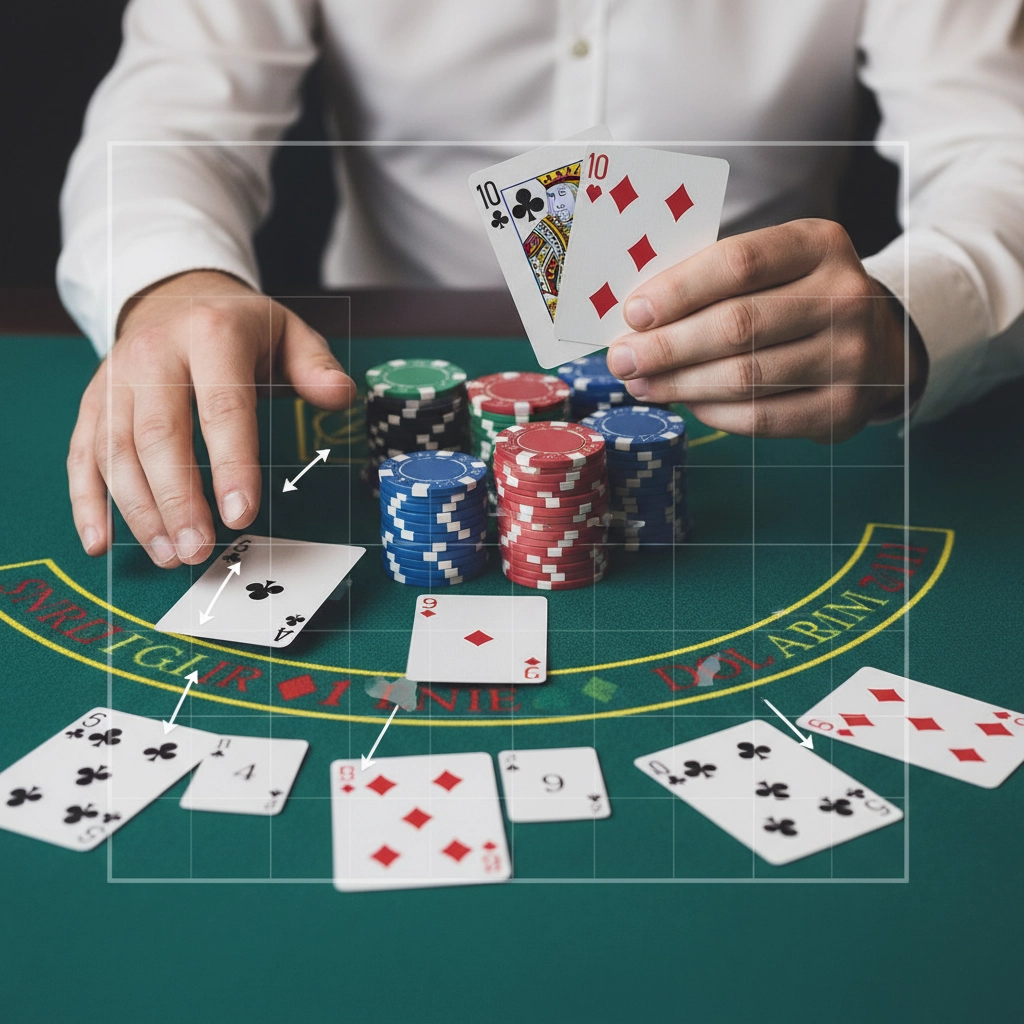
Small rule variations that require simple adjustments
Not every casino uses the same rules; a few small changes do affect plays:
– Dealer hits soft 17 (H17): increases house edge and nudges a few doubles and hits (be slightly more conservative on soft doubles).
– No double after split (no DAS): avoid splitting certain pairs (like 2s and 3s) as often; splitting loses value when you can’t double afterward.
– Surrender allowed: always use early/late surrender on 16 vs 9–10/A (and hard 15 vs 10) when recommended by your chart.
– Number of decks: single-deck charts differ slightly; multi-deck charts are safer for common casino games.
Before you play, confirm table rules and use the matching chart. With consistent practice and awareness of these small adjustments, basic strategy will become a reliable, profit-preserving tool at every session.
Putting strategy into practice
Make basic strategy a habit before you play for real money. Focus on consistent decisions, bank-roll discipline, and confirming table rules so your chart matches the game. Start with low-stakes or free-play sessions, use short practice drills until choices are automatic, and avoid ad-hoc deviations based on “hunches.” For deeper study and downloadable charts that match common rule sets, see Wizard of Odds — Blackjack.
- Confirm table rules (decks, dealer S/H17, DAS, surrender) before using a chart.
- Practice the three hand types (hard, soft, pairs) until responses are reflexive.
- Use surrender and doubling options only when your chart recommends them.
- Track sessions and stick to bankroll limits—strategy reduces losses but doesn’t remove variance.
Frequently Asked Questions
Does following basic strategy guarantee I will win?
No. Basic strategy minimizes the house edge and gives you the best long-term expectation, but it cannot eliminate luck or variance. Expect swings; the strategy reduces average losses and maximizes long-term return, not a guaranteed win every session.
Can I use the same basic strategy chart at every casino?
Not always. Small rule differences (number of decks, whether the dealer hits soft 17, double-after-split, and surrender availability) change the optimal plays for a few hands. Always confirm table rules and use a chart that matches them.
What’s the fastest way to learn and retain basic strategy?
Combine short, focused practice sessions with drills: quiz apps, flashcards of common hands, and low-stakes or free-play tables. Memorize quick rules (e.g., stand on hard 17+, always split A-A and 8-8), then expand to the full chart. Repetition under simulated conditions makes decisions automatic at the table.