
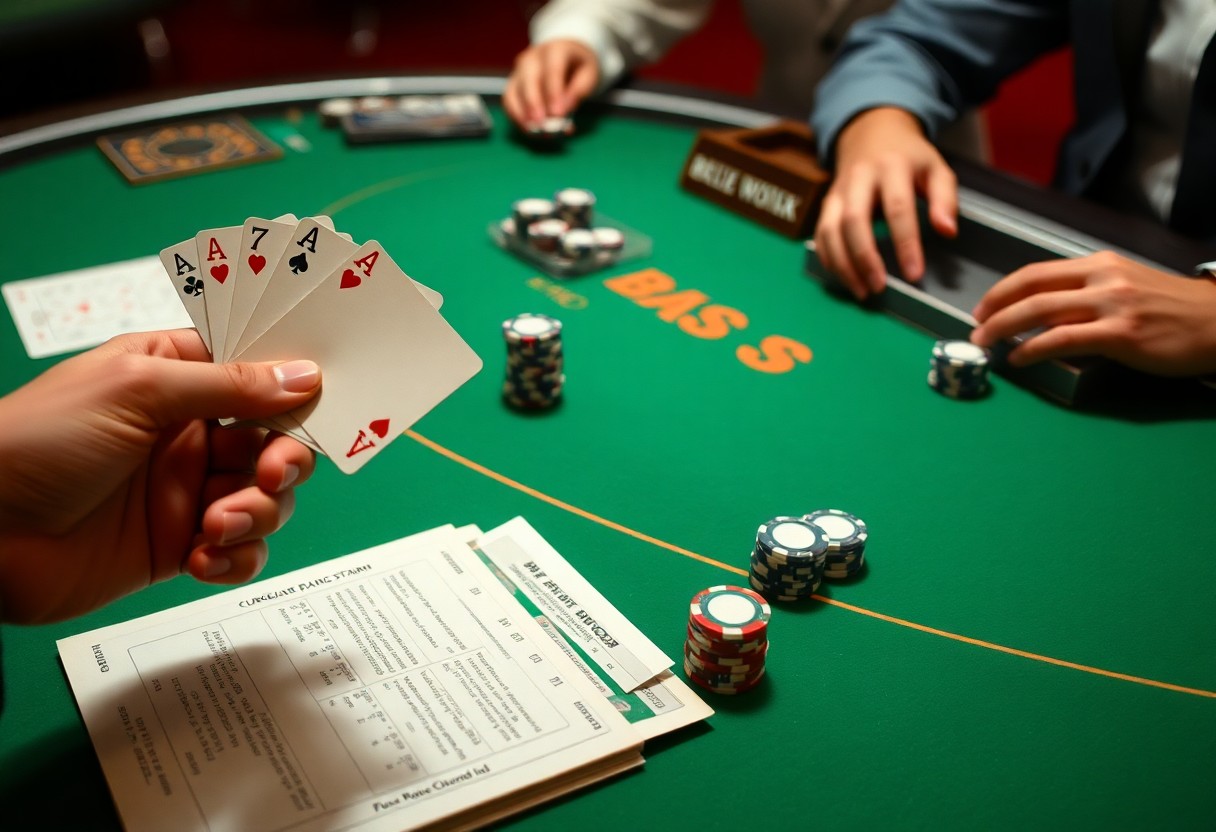
This guide gives a concise, authoritative overview of blackjack strategy to help players make informed decisions and avoid costly errors, focusing on basic strategy, proper bankroll management, when to hit, stand, split, or double, and why to never take insurance or chase losses; mastering dealer rules and table etiquette reduces risk while disciplined play improves long-term outcomes.
Types of Blackjack Games
Table rules vary by deck count, dealer action on soft 17, doubling and splitting options, and payout structure. Single-deck games often advertise 3:2 payouts but use higher minimums while 6-8 deck games lower variance and hinder card-counting. After comparing these elements, choose tables prioritizing dealer stands on soft 17 and genuine 3:2 payouts to minimize house edge.
- Classic Blackjack
- European Blackjack
- Atlantic City Blackjack
- Vegas Strip Blackjack
- Spanish 21
| Classic Blackjack | 1-8 decks; dealer usually stands on S17; 3:2 payout; DAS common. |
| European Blackjack | Typically 2 decks; dealer no hole card until player stands; doubling restrictions may apply. |
| Atlantic City | 8 decks; dealer stands on S17; DAS and late surrender often allowed; standard 3:2 payoff. |
| Vegas Strip | Usually 4 decks; dealer stands on S17; DAS and re-splits available at many casinos. |
| Spanish 21 | 48-card deck (no 10s); bonus payouts for 21s; rule set changes can swing house edge significantly. |
Classic Blackjack
Typically played with 1-8 decks; optimal basic-strategy play reduces house edge to roughly 0.5% under favorable rules. Dealer usually stands on soft 17, doubling after split is commonly allowed, and blackjack pays 3:2. Avoid splitting tens, as it’s a negative expected-value move.
Variations of Blackjack
Casinos offer variants like Spanish 21, Blackjack Switch, Double Exposure, and Super Fun 21 that alter deck composition, payouts, or dealer behavior. Spanish 21 removes tens and adds player bonuses; Blackjack Switch permits swapping second cards but often penalizes with dealer 22 rules. These tweaks can change the house edge by multiple percentage points, so adapt strategy.
For example, removing four tens per deck in Spanish 21 typically raises baseline house edge by up to a few percentage points, though generous player bonuses and late surrender can offset that. Blackjack Switch lowers variance via two-hand play and switching, yet the dealer-22 push rule costs equity. Also, accepting 6:5 payouts over 3:2 increases house edge by about 1.4%, so always check specific rules before committing.
Step-by-Step Guide to Playing Blackjack
Quick Play Checklist
| Step | What to do |
|---|---|
| 1. Bet | Place your wager within table limits; minimum/maximum affects bankroll strategy. |
| 2. Deal | Everyone gets two cards; dealer shows one upcard, one downcard (or checks for blackjack with Ace/10 up). |
| 3. Check for Blackjack | Blackjack normally pays 3:2; avoid tables that pay 6:5 when possible. |
| 4. Player Decisions | Hit, Stand, Double (first two cards), Split pairs, or Surrender if offered; double 11 versus most dealer upcards. |
| 5. Special Bets | Insurance is a separate bet against dealer blackjack-statistically unfavorable for players. |
| 6. Dealer Play | Dealer must follow house rules (hit/stand on soft 17); this rule changes the house edge. |
| 7. Payouts & Resolution | Compare hands; closer to 21 without bust wins, ties push; blackjack beats 21 from multiple cards. |
Understanding the Game Setup
Tables use between 1 and 8 decks; casinos often employ a shoe or continuous shuffler. Table rules like whether the dealer hits or stands on soft 17, whether doubling after split is allowed, and the blackjack payout (3:2 vs 6:5) directly alter the house edge-single-deck 3:2 games favor players more, while 6:5 payouts can add roughly ~1.4% to the house advantage.
Gameplay Mechanics
After the deal, players choose Hit, Stand, Double, Split, or Surrender based on hand and dealer upcard. For example, basic strategy commonly prescribes doubling 11 against any dealer upcard 2-10 and always splitting Aces and 8s. Insurance and side bets are typically negative EV; avoid insurance unless counting indicates otherwise.
Splitting specifics matter: split 8s and Aces, never split 10s; for 9s split versus dealer 2-6 and 8-9 but stand versus 7,10,Ace. Casinos vary on resplitting (often up to 3-4 times) and whether doubling after split (DAS) is allowed-DAS reduces house edge. Rule differences like dealer hitting soft 17 can add ~0.2% to house edge, and using 6-8 decks versus a single deck shifts expected returns by several tenths of a percent, so choose rules-savvy tables when possible.
Key Factors Influencing Game Strategy
Several variables shape optimal play: deck count, dealer rules, penetration, doubling & splitting, table limits, and card counting. A six- or eight-deck shoe and a dealer hitting soft 17 typically raise house edge by ~0.2-0.5%; surrender and double-after-split options cut the edge. Penetration above 70% makes counting practical, while tight limits increase variance for short sessions. Any adjustment to bets should prioritize rules and bankroll management.
- Deck count
- Dealer rules
- Penetration
- Doubling & splitting
- Table limits
- Card counting
Dealer’s Upcard
Dealer upcards drive decision weighting: 2-6 show elevated bust rates (approx 35-42%), so standing on 12-16 is often correct; 7-A reduce bust odds (~12-26%), forcing hits or doubles. For example, basic strategy tells you to stand on 12 vs a dealer 4 and hit the same 12 vs a dealer 7. An Ace upcard lowers bust probability to about 12%, making insurance poor value unless counts justify it.
Player’s Hand Value
Hard, soft, and pair classifications change action: treat soft totals as flexible-soft 17 (A‑6) is a hit vs 9-A but double vs 3-6; hard 12-16 are defensive vs dealer 2-6 and aggressive vs 7-A; split 8s and Aces for positive expectancy, while 10s are best kept together. Correct play can shave tenths of a percent off the house edge; misplays inflate losses.
Digging deeper, use examples: doubling 11 vs dealer 6 gains noticeable EV compared with hitting, and surrendering 16 vs a dealer 10 can save roughly 0.5-1% over forced play. Count-based deviations matter too-insurance becomes +EV around a true count of +3 in Hi-Lo, and standing on 16 vs a dealer 10 can flip from -0.8% to slightly positive with high counts. Track situations where a single decision changes EV by tenths of a percent and adjust consistently.
Tips for Smart Play
Prioritize technical plays: apply basic strategy to lower mistakes – it can reduce the house edge to roughly 0.5% under common rules (dealer stands on soft 17, double after split allowed). Avoid insurance since it increases expected loss; split A,A and 8,8, never split tens, and double 11 against any dealer upcard. Manage your bankroll by staking 1-3% per hand. The steady choice is flat betting at 1-2% to control variance.
- Basic strategy – match chart to deck count and S17/H17 rules
- Bankroll – bet 1-3% per hand for longevity
- Splitting – split A,A and 8,8; never split 10s
- Insurance – generally a negative expectation bet
- Table selection – prefer 3:2 blackjack and liberal doubling rules
Basic Strategy Chart
Match your basic strategy chart to the game’s deck count and whether the dealer hits soft 17; a 6-deck S17 chart differs from a single-deck H17 chart. For example, in many 6-deck S17 games you stand on 12 versus dealer 4-6, hit 16 versus dealer 10, and double 10 against dealer 9 or less. Carry a laminated chart or memorize 20-25 frequent plays to cut decision errors and reduce the house edge.
Betting Strategies
Favor flat betting for steady sessions; wagering 1-3% preserves bankroll and reduces bust risk. Avoid volatile systems like Martingale, which can require large stacks after streaks and doesn’t change expected value. If you have a measurable edge, use fractional Kelly sizing; otherwise focus on consistent, small bets to manage variance and extend play.
Concrete example: a Martingale starting at $10 needs bets of 10, 20, 40, 80, 160, 320 – total $630 – after six losses, which quickly exhausts typical bankrolls. Empirical tests show flat betting yields longer sessions and predictable variance; with a 1% card-counting edge, full Kelly suggests about a 1% wager, while many professionals use half-Kelly to limit drawdown.
Common Mistakes to Avoid
Mistakes that repeat at tables shave profits quickly: overbetting, chasing losses, and ignoring dealer upcards. Basic strategy can reduce the house edge to around 0.5%, but poor choices-like playing every hand at full bet or using martingale-style doubling-destroy bankrolls. Set session limits, use a betting plan, and treat each hand as a calculated event, not a reaction to the last outcome.
Playing Too Many Hands
Playing excessive hands magnifies the house edge: at 0.5% edge a $100 bet loses about $0.50 per hand, so 200 hands average $100 in expected loss. Rapid play also increases fatigue and deviation from basic strategy; players who deal more than 300 hands per hour tend to make more mistakes. Reduce hands per session, skip side bets, and stick to preset stop-loss and cash-out rules.
Ignoring the Dealer’s Card
Overlooking the dealer’s upcard wastes a major edge: dealers show the highest bust rates with 4-6 (~40% bust probability), so standing on hard 12-16 versus those upcards is often correct. When the dealer shows 7-Ace they complete to stronger totals, so you must hit or double more aggressively. Let the upcard guide splits, doubles and stands instead of gut reactions.
Specific adjustments matter: stand hard 12 vs 4-6, hit hard 12 vs 2-3 and 7-Ace, double 11 against any upcard except Ace, always split Aces and 8s, and never split 10s; surrender 16 vs 9-Ace when allowed. Following these rules exploits dealer probabilities and can shave tenths of a percent off expected loss compared with naive play.
Pros and Cons of Different Strategies
When deciding on a method, compare expected edge and volatility: basic strategy lowers the house edge to about 0.5%, whereas disciplined card counting (e.g., Hi‑Lo on 6 decks with ~70% penetration) can produce a player advantage of 0.5-1.5% when paired with an appropriate bet spread. Conservative lines reduce variance and protect bankrolls; aggressive approaches boost potential hourly win rate but substantially increase the risk of large drawdowns and detection by casinos.
| Pros | Cons |
|---|---|
| Basic strategy: reduces house edge to ~0.5%. | Low per-hand win rate; slow bankroll growth. |
| Card counting: can create a player edge of 0.5-1.5% with good penetration. | Requires practice; casinos use countermeasures and shuffling to neutralize it. |
| Flat betting (conservative): minimizes volatility and ruin probability. | Misses upside from favorable counts and big-win opportunities. |
| Large bet spreads (aggressive): amplifies expected return on high counts. | Big bankroll swings and higher detection risk by staff. |
| Insurance when count high: can be +EV in rare situations. | Generally negative expectation; often a long-term loser. |
| Late surrender: reduces losses on doomed hands. | Not offered at many tables; complicates strategy charts. |
| Team play: spreads detection risk and can scale advantage. | Requires coordination, profit splitting, and carries ethical/legal concerns. |
| Progressive systems (e.g., Martingale): can recover short streak losses. | High chance of catastrophic loss due to table limits and bankroll limits. |
Conservative Play
Conservative players stick to basic strategy and small, consistent bets to preserve capital; with a $1,000 bankroll and $5-$10 bets the house edge near 0.5% produces manageable variance and low ruin probability. This is ideal for short sessions and limited-bankroll players, but it means growth is incremental and you won’t capitalize on high-count opportunities that could boost hourly win rates.
Aggressive Play
Aggressive play uses wide bet spreads, frequent doubles, and counting to convert occasional favorable counts into larger profits; for example, a solid Hi‑Lo counter using a 10:1 spread and 70% penetration can attain a 0.5-2% player advantage on high-count hands. That raises potential hourly wins but also demands strict bankroll sizing, accurate indices, and tolerance for steep variance.
Operationally, aggressive strategies face casino scrutiny-bet correlation with counts is spotted quickly-so expect increased attention, seating changes, or ejection. Bankroll models show that even with a 1% edge, standard deviation per session can be large, meaning you need reserves of roughly 100-200 bets to withstand typical losing swings.
Final Words
The disciplined application of basic strategy, proper bankroll management, and awareness of house rules empowers players to make informed decisions, reduce common errors like chasing losses or misplaying soft hands, and evaluate risk objectively. Practice, study of dealer tendencies, and avoiding myths turn uncertainty into measurable choices that improve outcomes and preserve capital.
FAQ
Q: What is the objective of blackjack and how are cards valued?
A: The goal is to beat the dealer by having a hand value closer to 21 without going over. Number cards count at face value, face cards (J/Q/K) count as 10, and Aces count as 1 or 11 depending on which benefits the hand. A two-card 21 (Ace + 10-value) is a “blackjack” and usually pays 3:2, while regular wins pay 1:1; insurance and side-bet payouts vary and are generally unfavorable. Players act first and may hit (take cards), stand (keep total), double down (double bet and take one final card), split pairs (create two hands with an extra equal bet), or surrender where available (forfeit half bet). Dealer procedures (hit/stand on soft 17) and the number of decks used affect house edge, so check table rules before playing.
Q: What practical strategies help me play smart and reduce the house edge?
A: Use a basic strategy chart tailored to the game’s rules and deck count; it prescribes mathematically optimal plays for every player total vs. dealer upcard (when to hit, stand, double or split). Manage your bankroll with fixed session limits and unit bet sizing to avoid erratic play and emotional decisions. Decline insurance and most side bets because they increase the house edge. Learn distinctions between soft and hard totals (e.g., soft 17 vs hard 17) and apply doubling and splitting rules accordingly. Advanced players may study card counting to gain an edge, but it requires practice, camouflage, and awareness that casinos may ban counters.
Q: What common mistakes cause unnecessary losses and how can I avoid them?
A: Chasing losses by increasing stakes after losses, deviating from basic strategy under pressure, and taking insurance or frequent side bets are major money drains. Misplaying Aces and eights (failing to split), doubling when not indicated by strategy, and confusing soft vs hard totals lead to suboptimal outcomes. Poor bankroll management-playing with money you cannot afford to lose or betting inconsistent amounts-amplifies variance. To avoid these errors: study and follow a basic strategy chart, set stop-loss and win-goal limits, practice bankroll discipline, avoid alcohol while playing, and choose tables with favorable rules (fewer decks, dealer stands on soft 17, 3:2 blackjack payouts).