

Discover why online blackjack is a smart choice for new players
You’re likely drawn to online blackjack because it’s fast to learn, widely available, and offers one of the lowest house edges among casino games when you play correctly. Unlike many table games that depend heavily on luck, blackjack gives you meaningful decisions every hand. That combination — straightforward rules plus decision-making — makes it ideal if you want a game that rewards good basic strategy and sensible bankroll management.
When you play online, you get additional conveniences: you can practice with free play tables, choose different rule variants, and play at your own pace without pressure from an in-person dealer. You’ll also find single-deck and multi-deck games, live-dealer tables that mimic a real casino experience, and automated $1–$100 tables if you want quick, consistent sessions.
Understand the basic goal, table layout, and betting flow
Before you place your first bet, make sure you understand the objective and the typical online table layout so you know what each area and button does:
- Objective: Your aim is to get a hand total closer to 21 than the dealer’s hand without going over 21 (busting).
- Card values: Number cards count at face value, face cards (J/Q/K) count as 10, and an ace counts as 1 or 11, whichever benefits your hand more.
- Table layout: You’ll see places to place bets, buttons for actions (Hit, Stand, Double, Split, Surrender in some games), and information panels showing your balance, bet size, and sometimes dealer rules.
- Betting flow: You place a wager, receive two cards, then decide whether to hit (take another card), stand (keep your total), double (double the bet and take one final card), or split (separate two equal-value cards into two hands).
Which betting options and side rules to watch for
Not all online blackjack games are identical. As you explore tables, pay attention to a few rule differences that change your expected return:
- Does the dealer hit or stand on soft 17? Dealer standing on soft 17 slightly improves your odds.
- How many decks are used? Fewer decks generally favor the player when basic strategy is applied.
- Is late surrender allowed? Late surrender can reduce losses on certain tough hands.
- What’s the payout for a blackjack? Standard payout is 3:2; some games pay 6:5, which is worse for you.
Choosing games with favorable rules and practicing in free mode will give you the best start. Next, you’ll learn the specific rules for each action (hit, stand, double, split, surrender), how card totals are calculated in different scenarios, and a simple basic strategy to follow at the table.
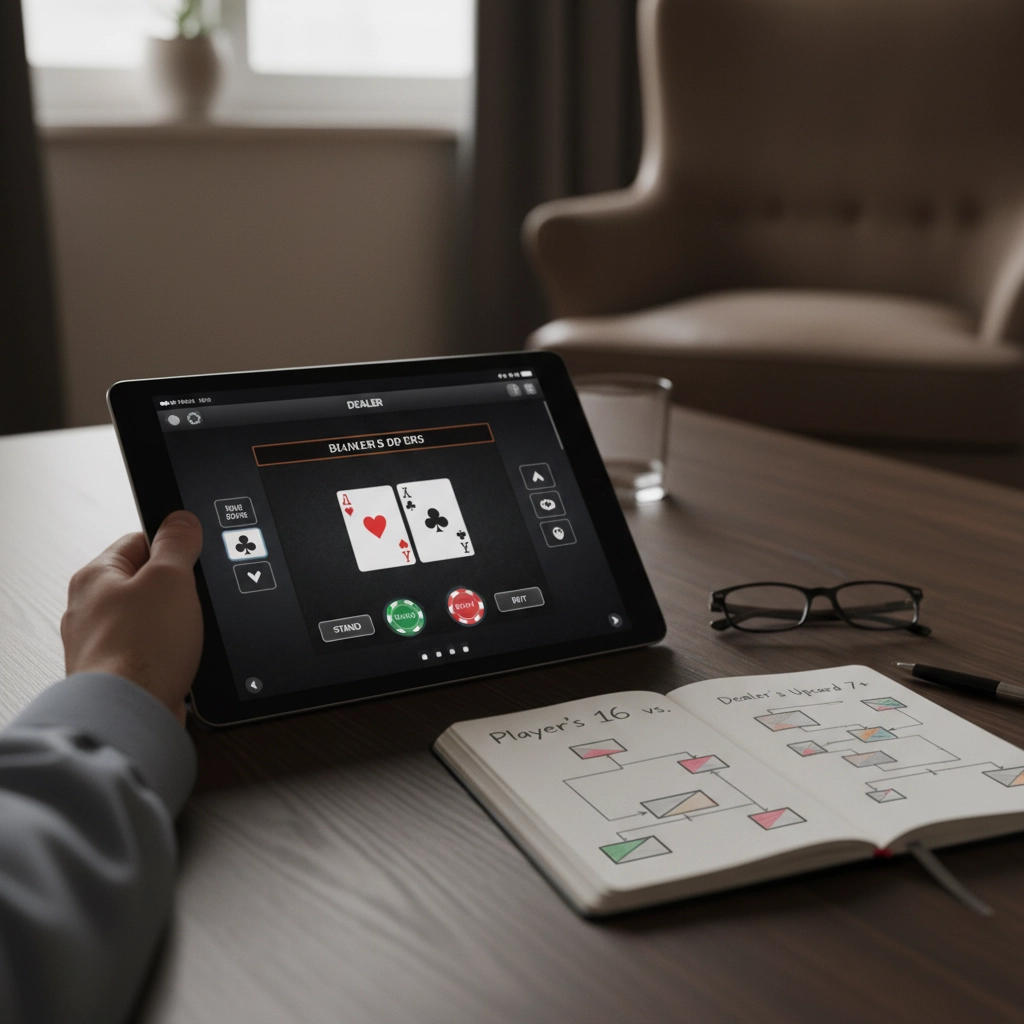
How each action works — hit, stand, double, split, and surrender
Once the cards are dealt you have a handful of choices. Knowing exactly what each action does — and when it’s allowed — prevents costly mistakes.
- Hit: Take another card to improve your total. Keep hitting until you stand or bust (go over 21). Example: With a hard 12 vs dealer 6 you usually stand, but with dealer 7 you would hit.
- Stand: End your turn and lock in your total. If the dealer busts, any non-busted hand wins.
- Double (down): Double your original wager, take exactly one more card, then stand. Doubling is a powerful move when you have a good chance to beat the dealer with one card — commonly on totals of 10 or 11 (e.g., 11 vs dealer 6).
- Split: If your first two cards are the same value, you can split them into two separate hands, matching your original bet on the second hand. Each hand is then played independently. Key splits to remember: always split aces and 8s; never split 10s.
- Surrender: Available at some tables as “early” or “late” surrender. Late surrender means giving up half your bet and ending the hand after the dealer checks for blackjack — useful on hands like a hard 16 vs dealer 10. Not every game offers surrender; it can improve your long-term return when available.
Also note a few dealer and table rule interactions: whether the dealer hits or stands on a soft 17 changes some doubling/splitting decisions, and whether the casino allows doubling after splitting (DAS) affects the value of split hands. Check the table rules panel before you play.
Simple basic strategy new players can follow
You don’t need a full chart memorized at first — learn these straightforward guidelines and practice them in free mode. They’ll cut the house edge dramatically vs playing by instinct.
- Hard totals (no ace counted as 11): Stand on 17 or higher. On 13–16, stand if the dealer shows 2–6 (dealer likely busts); otherwise hit. On 12, stand vs dealer 4–6, hit vs 2–3 or 7–Ace.
- Soft totals (ace counts as 11): With soft 19 or 20, stand. With soft 18, stand vs dealer 2–8, hit vs 9–Ace (double vs dealer 3–6 if allowed). With soft 13–17, double vs dealer 4–6 when allowed, otherwise hit.
- Pairs: Always split aces and 8s. Split 2s and 3s vs dealer 2–7 (if DAS allowed, even better). Split 6s vs dealer 2–6. Never split 10s or 5s (treat a pair of 5s as 10 and consider doubling).
- Insurance: Generally avoid it. Insurance is a separate bet that pays if the dealer has blackjack; mathematically it’s a bad bet for the average player.
Use a downloadable or on-screen basic strategy chart as a cheat-sheet while you practice. Over time the rules become second nature.

Practical bankroll and session tips for online beginners
Good strategy minimizes the house edge, but bankroll control keeps you playing long enough to apply it. Follow a few simple rules:
- Set a session bankroll and stick to it. Only play with money you can afford to lose.
- Use flat betting (same bet size per hand) while you’re learning basic strategy. Increase bets only when you’re confident and the table rules are favorable.
- Limit session length and set win/loss stop points (for example, quit after a 50% gain or a 30% loss of your session bankroll).
- Practice in free-play mode to build speed and decision confidence before betting real money. Live-dealer games move slower; use them when you want a more realistic pace.
These habits protect your bankroll and reduce tilt — emotional decisions after losses — so you can make the mathematically correct plays more consistently.
Putting your knowledge into practice
Ready to play? Start small, focus on steady improvement, and treat each session as practice in decision-making rather than a quick way to win. Use free-play tables to build speed, keep a basic strategy chart handy while you learn, and set strict session limits so you don’t chase losses. If you want deeper study or printable charts, check reputable resources like Blackjack strategy resources.
Above all, play responsibly: pause when you feel tilted, stick to your bankroll rules, and remember that blackjack is entertainment with an edge you can manage through discipline and practice.
Frequently Asked Questions
Can I learn blackjack online for free before betting real money?
Yes. Most online casinos and gaming sites offer free-play or demo tables that let you practice without risking funds. Use these to get comfortable with the interface, timing for live-dealer games, and following basic strategy before you switch to real-money play.
Which table rule affects my odds the most when choosing an online blackjack game?
The payout for a natural blackjack (3:2 vs 6:5) has one of the largest single impacts on expected return. Other important rules are whether the dealer hits or stands on soft 17, the number of decks used, and whether late surrender or doubling after split is allowed. Prefer tables with 3:2 payouts, dealer standing on soft 17, and favorable doubling/splitting rules.
When should I surrender, split, or double?
Follow a basic strategy chart for precise situations, but as quick guidance: surrender (when available) on very weak hands like hard 16 against a strong dealer upcard to limit losses; always split aces and eights, and never split tens; double on strong totals like 10 or 11 versus weaker dealer upcards (and on certain soft hands when the dealer shows 4–6). Practice these moves in free play to internalize them.