
Why mastering ranges will transform your decision-making at the table
You already know that poker is a game of incomplete information. What separates a competent player from an advanced one is the ability to think in ranges rather than individual hands. When you start constructing and visualizing ranges, you stop guessing and begin estimating frequencies — which means better sizing choices, more accurate bluffs, and clearer value bets. This guide begins by giving you the solver framework you need and then shows practical ways to turn theory into repeatable skills.
Core solver concepts that inform modern range construction
Solvers compute game-theoretic optimal strategies by evaluating thousands of possible lines and counter-lines. You don’t need to be a programmer to benefit from solver output, but you do need to understand a few core concepts so you can interpret recommendations correctly:
- Range weight: Solvers assign weights to hands in a range (e.g., 40% of QJo). You should think in probabilities — how often each hand appears — rather than binary include/exclude decisions.
- Frequency balancing: A mixed strategy keeps your opponent guessing. If you always bet with top pairs and never with draws, you become predictable. Solvers show which hands should be mixed across bet sizes.
- Exploitability vs. practicality: Solver strategies are GTO-focused; they minimize exploitability. In live or pool-dependent games, you’ll balance GTO with exploitative adjustments based on opponent tendencies.
- Equity realization: Some hands have high raw equity but poor ability to realize that equity on future streets. Solvers reveal which hands to protect or fold to maximize realized value.
First practical steps: how to read solver output and translate it into play
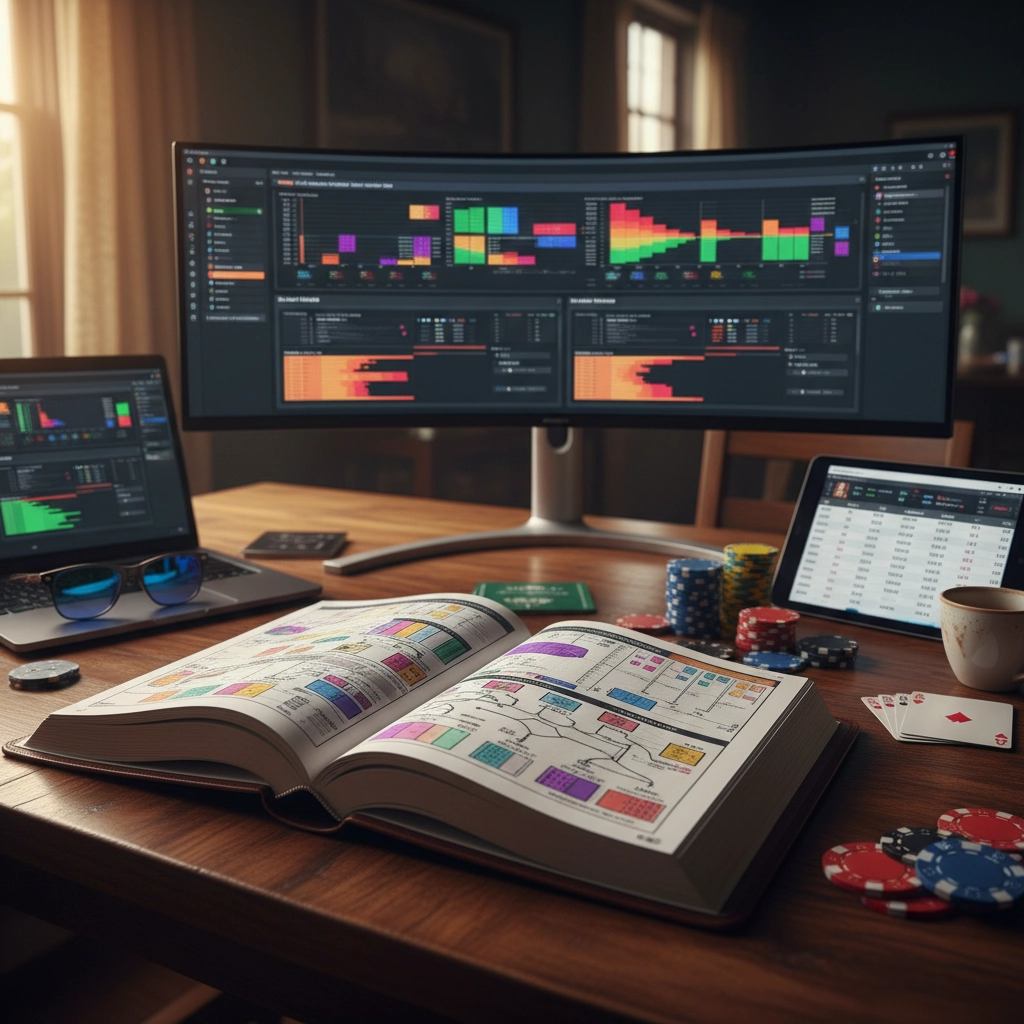
When you open a solver report, the raw data can be overwhelming: range trees, bet-mix heat maps, and EV differences. Approach this material with a stepwise routine so you convert insight into instincts:
- Scan range percentages first — identify which hands are core to each action and which are mixed.
- Look at bet-size distributions — notice which hands are primarily betting large, small, or checking, and how often.
- Check exploitative adjustments in spots where opponent ranges are narrow or overly aggressive/weak.
- Isolate 3–5 common street runouts and study how the strategy changes; repetition on a few textures builds pattern recognition faster than trying to memorize everything.
As you begin practicing, focus on pattern recognition rather than rote memorization: learn which hand classes perform similarly (e.g., medium pairs vs. medium suited connectors) and why. Your next step will be to build simple drills and session routines that turn solver insights into fast, actionable instincts at the table.
Practical drills to internalize solver ranges
Start small, then layer complexity. The goal of drills is not to memorize a solver tree but to build fast pattern recognition for common textures and betting intervals. Below are repeatable exercises you can do in 15–45 minute blocks.
– Range flashcards (15–20 minutes): Create 20–30 board/runout cards that represent common textures (e.g., dry A72 rainbow, paired boards, two-tone monotone draws, high-card coordinated boards). For each card, practice writing a short range for the preflop aggressor and responder (include weight buckets: 70–100%, 30–70%, How to weave solver practice into real sessions without overfitting
Bringing solver thinking to live or online play is about disciplined application, not slavish copying. Use the following session structure to keep practice efficient and relevant.
– Warm-up (5–10 minutes): Quick review of 2–3 solver spots you’ve drilled recently. Reinforce one default frequency table you’ll rely on (e.g., c-bet % on dry flop for EP opening).
– Focused play block (45–90 minutes): Play with a single study objective (e.g., defending vs. 3-bets from CO, or postflop play as the IP caller). Keep the objective visible and mark hands that hit your study area.
– Short solver checks (2–5 minutes between breaks): For hands you flagged, run the specific node in the solver for a quick reality check on one street — not the whole tree. This prevents paralysis-by-analysis and targets the biggest value leaks.
– Review block (15–30 minutes): After the session, run 5–10 flagged hands through the solver fully. Note recurring mistakes (wrong sizing ranges, under-mixed bluffs, over-folding) and convert them into the next session’s drill list.
Prevent overfitting by sticking to simplified action plans: create 2–3 default strategies per major spot (e.g., default c-bet small 50% on dry flops, default check-behind with weak pairs on paired runouts) and only deviate when you have concrete opponent reads. Use HUD stats and exploitative adjustments sparingly, always checking that your exploit doesn’t create large counter-exploitable holes.
Quantifying progress and deciding what to improve next
Measure improvement with targeted metrics rather than vague intuition.
– Tracking metrics: Record frequency-based stats from your hand database (c-bet frequency on dry/wet flops, fold-to-bet on turn after calling flop, river bluff success). Compare your empirical frequencies to solver recommendations; the delta shows where you’re most off.
– Prioritize high-swing spots: Focus first on spots that cost the most EV per mistake — common postflop positions, single-street decisions that occur often, and large-pot river choices. Small leaks in rare lines are low priority.
– Iterate with micro-goals: Set one measurable goal for each week (e.g., reduce over-folding to river bluffs by 10 percentage points; increase correct block-bet frequency). Use drills and session routines to address the goal, then re-measure.
Consistent, focused practice that emphasizes frequency awareness and quick street-level decisions will let solver theory evolve into reliable table instincts without turning you into a robot.
Common pitfalls and quick fixes
- Over-reliance on exact solver lines — Fix: Abstract the logic (range roles, blockers, hand classes) and create simple default plans you can apply without a solver.
- Neglecting opponent tendencies — Fix: Start with solver frequencies, then layer one or two exploitative adjustments backed by HUD/read data.
- Inconsistent practice — Fix: Use short, scheduled drills (15–45 minutes) and track one measurable metric each week.
- Ignoring bet-size context — Fix: Practice bet-size recognition drills and map common sizing-to-range relationships so you react fast at the table.
Sustaining solver-informed growth
Make solver study part of a repeatable routine: short, focused drills, selective in-session checks, and post-session reviews that turn mistakes into micro-goals. Keep your practice practical — aim to translate solver principles into a few robust defaults per spot and only deviate when you have clear reads. When you need deeper analysis or a reference tool, resources like PioSOLVER can help you explore precise nodes and sizing interactions without derailing your everyday rhythm.
Frequently Asked Questions
How often should I consult a solver for hands I played?
Use quick solver checks between breaks for high-impact lines (2–5 minutes) and reserve full-tree analysis for a small weekly review (5–10 hands). Prioritize hands that expose recurring mistakes or large pots rather than every marginal decision.
Won’t using solver ranges make my play too predictable or exploitable?
Solvers provide frequency-based equilibria, not rigid scripts. The goal is to internalize balanced tendencies and apply small, targeted exploits based on reads. Keep 2–3 default strategies per common spot to stay balanced and avoid predictable deviations.
Which single metric should I track first to measure progress?
Start with a frequency metric that maps directly to common mistakes—c-bet frequency on dry flops or fold-to-bet on the turn after calling the flop are good choices. Compare your empirical frequency to solver-recommended ranges and track the delta over weeks.
Why mastering ranges will transform your decision-making at the table
You already know that poker is a game of incomplete information. What separates a competent player from an advanced one is the ability to think in ranges rather than individual hands. When you start constructing and visualizing ranges, you stop guessing and begin estimating frequencies — which means better sizing choices, more accurate bluffs, and clearer value bets. This guide begins by giving you the solver framework you need and then shows practical ways to turn theory into repeatable skills.
Core solver concepts that inform modern range construction
Solvers compute game-theoretic optimal strategies by evaluating thousands of possible lines and counter-lines. You don’t need to be a programmer to benefit from solver output, but you do need to understand a few core concepts so you can interpret recommendations correctly:
- Range weight: Solvers assign weights to hands in a range (e.g., 40% of QJo). You should think in probabilities — how often each hand appears — rather than binary include/exclude decisions.
- Frequency balancing: A mixed strategy keeps your opponent guessing. If you always bet with top pairs and never with draws, you become predictable. Solvers show which hands should be mixed across bet sizes.
- Exploitability vs. practicality: Solver strategies are GTO-focused; they minimize exploitability. In live or pool-dependent games, you’ll balance GTO with exploitative adjustments based on opponent tendencies.
- Equity realization: Some hands have high raw equity but poor ability to realize that equity on future streets. Solvers reveal which hands to protect or fold to maximize realized value.
First practical steps: how to read solver output and translate it into play
When you open a solver report, the raw data can be overwhelming: range trees, bet-mix heat maps, and EV differences. Approach this material with a stepwise routine so you convert insight into instincts:
- Scan range percentages first — identify which hands are core to each action and which are mixed.
- Look at bet-size distributions — notice which hands are primarily betting large, small, or checking, and how often.
- Check exploitative adjustments in spots where opponent ranges are narrow or overly aggressive/weak.
- Isolate 3–5 common street runouts and study how the strategy changes; repetition on a few textures builds pattern recognition faster than trying to memorize everything.
As you begin practicing, focus on pattern recognition rather than rote memorization: learn which hand classes perform similarly (e.g., medium pairs vs. medium suited connectors) and why. Your next step will be to build simple drills and session routines that turn solver insights into fast, actionable instincts at the table.
Translating ranges into simple, at-the-table heuristics
Solvers are excellent teachers, but at the table you need fast rules of thumb that approximate solver logic. Here are compact heuristics you can carry into play without opening a laptop:
- Dry high-card boards (Axx rainbow): C-bet smaller and more frequently as IP (around 50–70% frequency); prefer top pairs and strong Ax combos for larger sizing. Out of position, defend more with hands that have showdown value and blockers to strong Ax (KQ with a backdoor heart is a candidate).
- Two-tone or monotone boards: Size down with thin value and polarized bluff-range hands. Solvers often mix check and small-bet to protect equity; think in terms of “thin value vs. blocker bluff” rather than exact combos.
- Paired boards: Reduce c-bet frequency and lean into check-calling with medium pairs and overcards with backdoor equity; many marginal hands stop realizing equity, so be ready to give up to consistent aggression.
Use these heuristics as defaults and add one exploit per opponent (e.g., if villain folds too much to turn bets, increase small-turn bluffs by a few percentage points). The goal is to preserve balance while earning extra EV from observable leaks.
Mental shortcuts and decision trees for speed
Turn solver output into compact decision trees you can run through in under 10 seconds. Example flow for facing a flop as the preflop aggressor:
- Step 1 — Board type? Dry / coordinated / monotone / paired.
- Step 2 — My hand class? Top pair/overset/strong draw/weak pair/drawless overcard.
- Step 3 — Default action based on combination: dry + top pair = small c-bet 60–80%; coordinated + weak pair = check; monotone + backdoor draw = small stab or check depending on position and stack depth.
- Step 4 — Adjust +/− for opponent: passive? increase small value bets. Aggressive? reduce bluff frequency and favor hands that realize showdown value.
Practice these trees until the steps are automatic; they dramatically reduce mental load and keep your play close to solver recommendations without paralysis in real-time spots.
Examples: common board textures and quick-range sketches
Below are rough starter ranges you can use as mental anchors. They’re intentionally simple — think in classes and weights, not exact combos:
- Dry A-7-2 rainbow (IP c-bet): Value: all Ax (80–100%); medium pairs (60–80%); backdoor draws and some suited connectors (20–40%).
- J-T-8 two-tone (IP): Value: all sets and two-pair (100%); top pair top kicker (80–100%); strong overs and combo draws (60–80%); thin runner-runner draws and weak pairs (20–40%).
- 9-9-4 paired (OOP): Defensive line: check more frequently; call down with medium pairs and strong blockers; avoid barreling thin with high-card air.
These sketches aren’t rules, they’re starting points. The more you practice matching these anchors to solver output, the faster you’ll recognize when a hand belongs in a 70–100% bucket versus a 10–30% mixed bucket.
Practical drills to internalize solver ranges
Start small, then layer complexity. The goal of drills is not to memorize a solver tree but to build fast pattern recognition for common textures and betting intervals. Below are repeatable exercises you can do in 15–45 minute blocks.
– Range flashcards (15–20 minutes): Create 20–30 board/runout cards that represent common textures (e.g., dry A72 rainbow, paired boards, two-tone monotone draws, high-card coordinated boards). For each card, practice writing a short range for the preflop aggressor and responder (include weight buckets: 70–100%, 30–70%, How to weave solver practice into real sessions without overfitting
Bringing solver thinking to live or online play is about disciplined application, not slavish copying. Use the following session structure to keep practice efficient and relevant.
– Warm-up (5–10 minutes): Quick review of 2–3 solver spots you’ve drilled recently. Reinforce one default frequency table you’ll rely on (e.g., c-bet % on dry flop for EP opening).
– Focused play block (45–90 minutes): Play with a single study objective (e.g., defending vs. 3-bets from CO, or postflop play as the IP caller). Keep the objective visible and mark hands that hit your study area.
– Short solver checks (2–5 minutes between breaks): For hands you flagged, run the specific node in the solver for a quick reality check on one street — not the whole tree. This prevents paralysis-by-analysis and targets the biggest value leaks.
– Review block (15–30 minutes): After the session, run 5–10 flagged hands through the solver fully. Note recurring mistakes (wrong sizing ranges, under-mixed bluffs, over-folding) and convert them into the next session’s drill list.
Prevent overfitting by sticking to simplified action plans: create 2–3 default strategies per major spot (e.g., default c-bet small 50% on dry flops, default check-behind with weak pairs on paired runouts) and only deviate when you have concrete opponent reads. Use HUD stats and exploitative adjustments sparingly, always checking that your exploit doesn’t create large counter-exploitable holes.
Quantifying progress and deciding what to improve next
Measure improvement with targeted metrics rather than vague intuition.
– Tracking metrics: Record frequency-based stats from your hand database (c-bet frequency on dry/wet flops, fold-to-bet on turn after calling flop, river bluff success). Compare your empirical frequencies to solver recommendations; the delta shows where you’re most off.
– Prioritize high-swing spots: Focus first on spots that cost the most EV per mistake — common postflop positions, single-street decisions that occur often, and large-pot river choices. Small leaks in rare lines are low priority.
– Iterate with micro-goals: Set one measurable goal for each week (e.g., reduce over-folding to river bluffs by 10 percentage points; increase correct block-bet frequency). Use drills and session routines to address the goal, then re-measure.
Consistent, focused practice that emphasizes frequency awareness and quick street-level decisions will let solver theory evolve into reliable table instincts without turning you into a robot.
Common pitfalls and quick fixes
- Over-reliance on exact solver lines — Fix: Abstract the logic (range roles, blockers, hand classes) and create simple default plans you can apply without a solver.
- Neglecting opponent tendencies — Fix: Start with solver frequencies, then layer one or two exploitative adjustments backed by HUD/read data.
- Inconsistent practice — Fix: Use short, scheduled drills (15–45 minutes) and track one measurable metric each week.
- Ignoring bet-size context — Fix: Practice bet-size recognition drills and map common sizing-to-range relationships so you react fast at the table.
Sustaining solver-informed growth
Make solver study part of a repeatable routine: short, focused drills, selective in-session checks, and post-session reviews that turn mistakes into micro-goals. Keep your practice practical — aim to translate solver principles into a few robust defaults per spot and only deviate when you have clear reads. When you need deeper analysis or a reference tool, resources like PioSOLVER can help you explore precise nodes and sizing interactions without derailing your everyday rhythm.
Frequently Asked Questions
How often should I consult a solver for hands I played?
Use quick solver checks between breaks for high-impact lines (2–5 minutes) and reserve full-tree analysis for a small weekly review (5–10 hands). Prioritize hands that expose recurring mistakes or large pots rather than every marginal decision.
Won’t using solver ranges make my play too predictable or exploitable?
Solvers provide frequency-based equilibria, not rigid scripts. The goal is to internalize balanced tendencies and apply small, targeted exploits based on reads. Keep 2–3 default strategies per common spot to stay balanced and avoid predictable deviations.
Which single metric should I track first to measure progress?
Start with a frequency metric that maps directly to common mistakes—c-bet frequency on dry flops or fold-to-bet on the turn after calling the flop are good choices. Compare your empirical frequency to solver-recommended ranges and track the delta over weeks.